
Sorry, but your login has failed. Please recheck your login information and resubmit. If your subscription has expired, renew here.
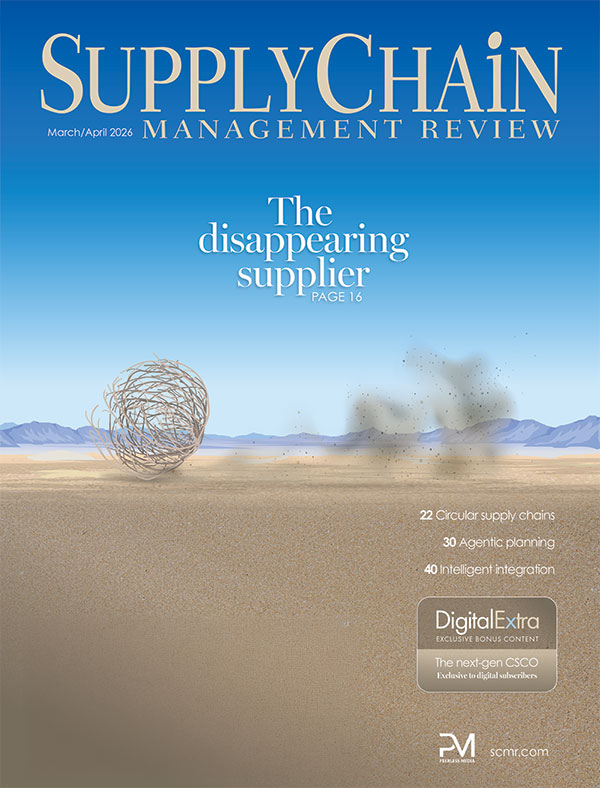
March-April 2026
The March/April 2026 issue of Supply Chain Management Review examines how supply chain leaders are managing supplier risk, circular supply chain design, AI-driven retail planning, CPG network optimization, and shifting LTL market dynamics to improve resilience and performance. Features include frameworks to prevent supplier failure, operationalize circular economy strategies, prevent retail stockouts using AI, and eliminate costly DC transfer patterns, plus insights from the 34th Annual Study of Logistics and Transportation Trends and a digital-exclusive on the evolving CSCO role. Browse this issue archive.Need Help? Contact customer service 1-508-503-1313 More options
Suppliers can “evaporate” without warning, making proactive supply chain risk management essential. Procurement leaders can take “intelligent risks” rather than defaulting to overly cautious, bureaucratic processes that hinder performance. He outlines five practical, low-cost techniques: assume some suppliers will fail and monitor predictive financial stability; streamline contracting to balance legal protection with efficiency; rigorously manage insurance, indemnification, and compliance data; optimize supplier portfolios with redundancy and structured scorecards; and diversify providers to balance stability with innovation. The goal is not eliminating risk, but building a secure, high-performing supply chain that protects value while enabling agility and long-term resilience.
SC
MR
Sorry, but your login has failed. Please recheck your login information and resubmit. If your subscription has expired, renew here.
March-April 2026
The March/April 2026 issue of Supply Chain Management Review examines how supply chain leaders are managing supplier risk, circular supply chain design, AI-driven retail planning, CPG network optimization, and… Browse this issue archive. Access your online digital edition. Download a PDF file of the March-April 2026 issue.Comprehensive supply chain performance is a top priority of many companies, especially those in the manufacturing sector. But much of a company’s supply chain is located outside a company’s own walls. Upstream of an organization are the suppliers who create goods and services used in the company’s own operations, whether as raw components or materials that flow into “direct” manufacturing as raw materials, or the “indirect” products and services which facilitate the company’s actual operations. The downstream supply chain is what an organization needs to efficiently distribute its products or services to customers. Contracted suppliers, both upstream and downstream, must be proactively managed as to minimize financial, confidentiality, operational, reputational, and legal risks.
In my final corporate role directing sourcing and contracting management activities for a firm in the Fortune 20, the executive to whom I reported gave me a curious objective in my written job description. From that year onward, along with other measurements, my boss evaluated my willingness to take “intelligent risks.” You see, he realized that an overly-aggressive approach to sourcing and management for an enterprise with 195,000 employees and 110 subsidiary companies around the world could hinder our ability to be “fast and nimble” in the economic sectors where we competed.
Over the next few years, that focus made a huge difference in my career as I learned how to execute well-researched business plans while properly managing risk. My success was measured by balancing well-researched, cost-saving initiatives with carefully thought-out fallback plans. I always knew that my performance evaluations would suffer if I failed to push the limit of what we could succeed in the supply chain arena.
Unfortunately, too many business people weren’t taught that taking appropriate risk is “intelligent.” Far too many procurement or supply chain leaders are being beaten down into cumbersome processes by their firm’s own risk or legal groups. This may give the appearance of diligence, but actually reduces the firm’s ability to truly manage SCM performance in a risk-averse manner.
Shouldn’t we try to eliminate all supply chain and legal risk for our employers? The answer is “no.” Because the only way to truly eliminate risk would be to never conduct any procurement or contractual activities using third-party suppliers. Instead, a more rational objective for procurement and supply chain leaders should be to create a secure but high-performing supply chain. One in which risk can be minimized while value-added business relationships can flourish. True leaders should take intelligent risks. My boss would (annoyingly) remind me of Wayne Gretzky’s comment: “You miss 100% of the shots you never take.”
In the years since, I’ve been privileged to work in the consulting realm with many world-class procurement clients. The senior supply chain leaders who are most impressive are those who demonstrate a willingness to move forward with key supply chain improvement opportunities. These are people willing to take realistic risks in order to generate profits for the bottom line. These leaders though, are frustrated by staff and peers who fail to act quickly to enact positive change.
As this article’s title pledges, we’ll discuss five supplier risk management techniques here that any firm can deploy at little cost to enhance protections across your entire supplier portfolio.
Supplier risk management technique 1: Don’t be surprised when suppliers evaporate
Evaporation is an interesting occurrence in that it causes water to disappear from view, partially or completely. Fact: Out of any supplier population, a statistically valid portion of providers are going to experience a material change that compromises their ability to perform. Even worse, seemingly strong suppliers sometimes go “poof.” WatchMyCompetitor reports that “more than half (52%) of the companies in the Fortune 500 list of 2003 no longer exist today.” The U.S. Bureau of Labor Statistics confirmed in 2024 that 65% of companies fail during the first 10 years of existence. And recent reports indicate that YOY commercial bankruptcy filings increased by 26% from July 2024 to 2025 [note, some are driven by increased Chapter 11 filings due to restructuring opportunities]. So, how close to home are potential failures in your company’s supply chain?
Readers of Supply Chain Management Review who rely upon transportation sector providers were affected by many recent instances of supplier evaporation, such as the following.
- In 2017 when one of the seven-largest maritime shipping companies in the world (HanJin Shipping) announced bankruptcy and literally stopped operations in one day, leaving thousands of containers locked aboard ships anchored in harbors or tied up to docks around the world. This firm alone processed nearly 10% of Asia-American container shipments, plus many others impacting other trade locations between other national trade partners. This supplier failure left as many as 400,000 containers stranded.
- In 2023 when Yellow (Freight) Corporation closed its doors. At the time of bankruptcy, Yellow was the country’s third-largest less-than-truckload (LTL) carrier. With Yellow, subsidiaries like Reddaway and Holland also closed their doors, idling approximately 60,000 rolling units. NBC News reported that “The USA lost as much as 15% of its small-batch trucking capacity,” while the Wall Street Journal reported “The trucker’s competitors are reaping a windfall of business, while customers face rising shipping costs.”
- Business closures continued in 2024-2025, including carriers like 10 Roads Express (affecting 2,500 trucks), Arnold Transportation (402 trucks/trailers), Kal Freight (800 trucks), LTI Trucking (300 trucks), Davis Express, TGS Transportation, Montgomery Transport, Epic Lightning, etc.
Did these firms’ customers see these closures coming? Most did not and had shipments lost or delayed in transit. Failure to have simple visibility into just supplier financial stability can be partially blamed on these firms’ supply customers. Too often, users of freight services fail to regularly perform financial reviews or might occasionally do spot checks using a well-known rating service which has been criticized as having “data accuracy issues, including errors and missing info, leading to inflated or deflated scores, and data gaps, as not all vendors report, leaving incomplete pictures.” More about that firm’s deficiencies can be read at the Federal Trade Commission’s website.
The good news is that better sources for managing supplier financial and operational stability have now emerged in the marketplace, which rely upon ‘predictive financial stability’ reporting that is provided by a major credit rating agency on all of your firm’s suppliers. Including a broad range of other supplier stability information (like the insurance COI collection services mentioned later in this article), the availability of predictive financial stability data for a firm’s entire supplier community can be outsourced with little/no budgetary expense so that this information is available in digital platforms that warn procurement leadership of potential supply chain failures before they occur.
Supplier risk management technique 2: Innovation & efficiency in contracting management
Another example of taking “intelligent risks” can come from a procurement group’s approach to contracting management. The author’s firm regularly assists leading companies in revising or creating strategic portfolios of pro-forma contract templates. Contract streamlining is an emerging trend as smart companies understand the significant cost of negotiating bulky old-style contracts that are “onerous” (i.e. written in legal prose, lengthy, difficult to understand, one-sided protections, etc.). Many legal and procurement groups are finding that it is better to approach the marketplace with concise and well-balanced contract documents that result in greater acceptance from the suppliers. “Bigger is not always better” in commercial contracting. But today, many procurement contract portfolios are a great example of how “legal risk” can outweigh “business balance” and affect the contracting cycle time (and procurement efficiency).
Supplier risk management technique 3: Have strategic requirements for supplier insurance & limitations of liability
Whenever we use an external supplier to provide products or services on the upstream or downstream sides of our operations, we must evaluate our firm’s exposure to potential liability. A good contract should address the three-legged stool of (i) limitation of liability, (ii) indemnification, and (iii) supplier insurance protections. We should require every supplier to carry insurance for two reasons: First, so that the supplier firm is protected from legal or financial exposure that could limit its ability to continue supporting our contractual commitments. Second, so that our organization has a buffer of protection against direct or indirect claims from other third parties who may be affected by the contracted supplier’s actions or inactions.
A frequent point of failure by many procurement organizations is to fail to inspect a properly executed and endorsed Certificate of Insurance (COI) (known as Evidence of Insurance or EOI internationally) from each contracted supplier before contract actions occur. I’ll admit, it’s a pain to collect and properly review COIs from every contracted supplier. But studies performed by leaders in this space indicate that 80% or more of initial COI submissions do not conform to the language in our contract! An additional failure point is that a supplier’s policies of insurance rarely expire on the same date as the contract itself. Failure to proactively ensure that each policy is renewed and continues in effect through contract expiration means that our third leg of protection can disappear without our knowledge.
Any procurement team that is proactively managing the three-legged stool of risk protection must have resources in place to proactively collect and knowledgeably review COIs. The good news is that there are several no-cost supplier risk mitigation resources in the marketplace that can do this with little/no expense—thus effectively outsourcing these reviews to a highly-skilled team of professionals without any budgetary impact. For every one of your suppliers, and at little/no cost to a corporate customer (not a typo), these technology providers’ cloud platforms perform real-time tracking and notifications on key risk factors listed:
- verification of the supplier’s taxpayer identity;
- predictive financial stability ratings of supplier creditworthiness;
- active, continuous digital collection and verification of every supplier’s insurance policy coverage values (per occurrence and aggregate) and endorsements (additional insured, waiver of subrogation rights, etc.) against your firm’s requirements;
- active ongoing reporting (and initial 5-year lookback) for supplier bankruptcies, judgments, and lien filings;
- review supplier against up to 1,500 global watch and exclusion lists (including U.S. OFAC SDN, EU Consolidated, UK Modern Slavery, FATF/Wolfsberg, etc.);
- cyber security review of supplier’s outward-facing technology infrastructure;
- ongoing monitoring of 30,000 media sources for negative news regarding the supplier (for example, geopolitical event impact, labor disputes, legal disputes, plant closures, etc.);
- identification and verification of supplier diversity ownership credentials;
- optional collection of additional supplier data (for example, confidentiality requirements, code of conduct commitments, ISO certifications, OSHA/MSHA incidents, environmental compliance, etc.); and
- current contact information for the management of every supplier.
The last of these seems simple, but it is a mission-critical failure point for many companies. Does your firm even have current contact information for every supplier that sustains your operations? Currently, verified sales manager name, mobile number, and email are lacking for most companies’ suppliers in any centralized database. And what about the same contact information at a senior level within the supplier company? Who will be able to recover their shipments sooner after a hurricane, the shipper who is trying to call the carrier’s 1-800 switchboard number on a weekend, or the firm that has the carrier’s president’s or COO’s cell numbers?
How simple to move the collection, creation, and reporting of this type of information to an automated third-party at little or no cost. (Contact the author directly for names of provider(s) of the above information for your suppliers.)
Supplier risk management technique 4: Provider optimization & redundancy
Basic blocking and tackling here. As part of initial strategic sourcing and supplier selection, risk exposure techniques should be employed to ensure that over-consolidation of the supplier community does not occur. Too often, aggressive “sourcing” groups can award a contract to a ‘single source’ sole award contractor. That works fine until a disaster occurs, such as the financial failure of the supplier or a plant shutdown, etc.
Proper strategic sourcing should select a balanced supplier portfolio that neither requires multiple plants nor data center redundancy under the same provider (i.e. ability to manufacture, process data, or perform services in multiple locations) nor segment the provider relationship across multiple suppliers in a primary and secondary contractual manner. Doing this will ensure that we can sustain supply chain operations even in the event of a failure in one production location.
Once we have selected the right suppliers, we must manage them to ensure performance and minimize risk exposure. When the readers of this article were in school, they received report cards. The reason for report cards was threefold: First, to give the student feedback on their educational accomplishment. Second, to provide their parents with visibility into their child’s performance.
Third, to provide a useful reference tool for conversation between the teacher, parents, and student to discuss areas of potential improvement. Let’s face it, I would not personally have tried nearly as hard in school all the way through university level if those report cards didn’t keep showing up.
Far too many companies fail to provide their suppliers with a report card and feedback on how they are performing. For most companies, the exceptional few suppliers that do receive any scorecard are fewer than those that don’t. Any supplier who does not receive frequent feedback will probably assume that what they are doing is quite fine … even if they are not.
Top companies separate their supplier portfolio companies into categories based on financial spend or assigned risk using techniques like the Pareto Principle, for example:
- Class A suppliers: the 15% of suppliers representing 75% of total spend.
- Class B suppliers: the 25% of suppliers representing 15% of total spend.
- Class C suppliers: the 60% of suppliers representing 10% of total spend.
Using the type of categorization, a strategy of scoring and providing feedback can be developed. One useful strategy is to automate score carding and reporting to Class B and C suppliers utilizing systematized data capture on those firms’ many providers. Class A suppliers can be given report cards that contain more-subjective scoring feedback data. Often, Class A and some Class B providers are met with a ‘parent/teacher/student’ model so as to identify improvement opportunities and corrective actions for deficient performance. Class C suppliers are rated and moved ‘up or out’ based on their ability to meet objective performance objectives.
Supplier risk management technique 5: Look outside the box
Far too often, fear of failure causes business people to:
- unhealthily resort to “that’s the way we’ve always done it” in decision-making;
- avoid making difficult decisions;
- fail to try better ways of doing things;
- shift responsibility onto others;
- fail to acknowledge/confront problems; or
- try to eliminate every conceivable chance of failure.
As the old expression goes, “Nobody ever got fired for hiring IBM.” Great company. Long history. Safe. But in our company roles, are we making supplier selections with providers that are “safe” but quite average in performance? Or are we, with careful diligence, choosing innovative partners who will transform our business model?
I’ll bet your personal investment portfolio is not all in a single stock (if it is, please talk to a finance professional). A properly balanced portfolio will contain a number of investments across types, industries, and risk. Similarly, to manage risk in a high-performing supplier base, consider diversifying your portfolio of providers.
Billionaire Warren Buffett has referred to three types of firms that participate in any marketplace: “First come the innovators, then come the imitators, then come the idiots.” In your firm’s supplier portfolios, make sure you mix high-performing established firms with innovative market disruptors. Consider how companies like Amazon Freight, Uber, DoorDash, etc. are beginning to overlap into the arenas occupied by FedEx, UPS, DHL, etc.
To summarize, taking “intelligent risks” doesn’t mean we can fail to carefully research and structure our supply chain decisions. Writer John A. Shedd said this: “A ship in harbor is safe—but that is not what ships are for.” The same is true in supply chain management. If we don’t take some intelligent risks, we’re not going to provide maximum value to our employers.
About the author
Mark Trowbridge, CPSM, C.P.M., MCIPS, is president of Strategic Procurement Solutions and leading expert on negotiations. He can be reached at [email protected].
SC
MR


More Supplier Risk Management
 Explore
Topics
Procurement & Sourcing News
- Why companies blame the wrong supplier … and miss the real failure
- NextGen Supply Chain Conference unveils agenda focused on AI, execution and the future of leadership
- From fragmented negotiations to coordinated negotiation performance: an AI-enabled approach
- Supply chain resilience isn’t a data problem; it’s a judgment problem
- Why your supply chain risk management plan will fail
- When component verification becomes operational
- More Procurement & Sourcing
Latest Procurement & Sourcing Resources
Subscribe

Supply Chain Management Review delivers the best industry content.

Editors’ Picks



